


Latest Version
September 19, 2025
TINYBUILD LLC
Adventure
iOS
0
Report a Problem
More About :game
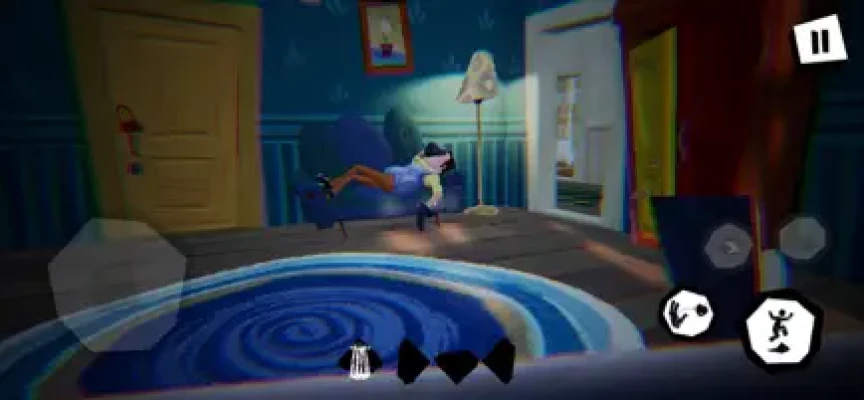
That adaptive behavior is one of the game's defining ideas. The official App Store description specifically highlights an AI that learns from your actions, including placing traps or cameras around routes you repeatedly use.
The iOS version is published by tinyBuild LLC, is available for iPhone and iPad, and currently has a 4.0/5 rating from approximately 135,000 ratings on the U.S. App Store.
What Is Hello Neighbor?
Hello Neighbor combines:
- Stealth
- First-person exploration
- Environmental puzzles
- Platforming
- Item-based problem solving
- Horror
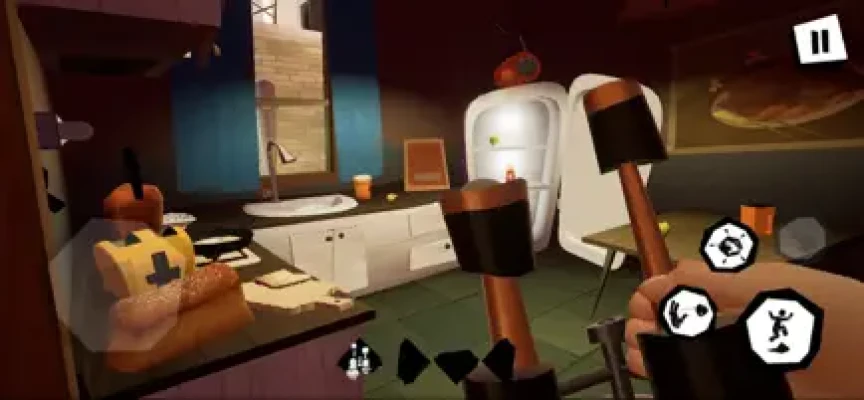
- House exploration
- AI-driven pursuit
You are not expected to fight the Neighbor in a conventional way. Your advantage comes from understanding his behavior, learning the house and finding ways to manipulate the environment.
The central gameplay loop is:
Observe → Explore → Find an item → Solve a puzzle → Avoid the Neighbor → Open a new area → Repeat
The deeper you go into the house, the stranger its architecture and puzzles become.
Story and Setting
The story centers around a mysterious Neighbor whose house hides secrets beneath its increasingly bizarre structure.
At first, the objective appears straightforward: get inside and investigate.
As you progress, however, the house becomes much more than an ordinary building. Rooms connect in unexpected ways, puzzles become increasingly elaborate and the basement reveals that there is considerably more to the story than the initial mystery suggests.
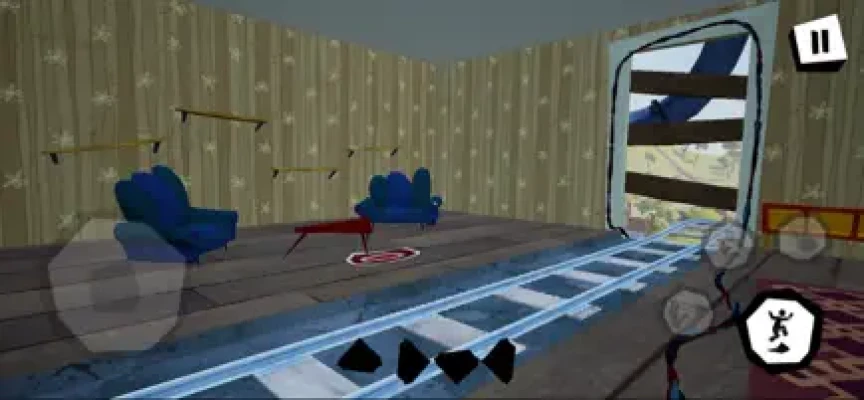
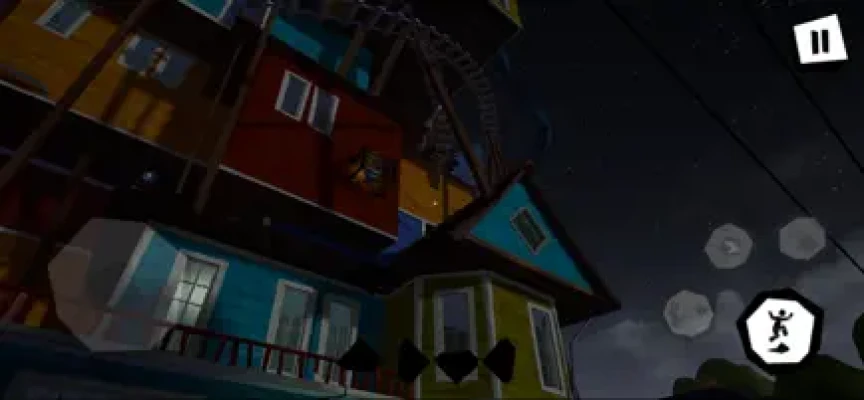
The surreal design is intentional. Hello Neighbor uses strange architecture, unusual objects and dreamlike sequences to turn the house itself into part of the mystery.
How the Gameplay Works
The Neighbor's house is effectively your main puzzle.
You need to determine:
- Which doors can be opened
- Which keys are required
- Which objects can be moved
- Which routes are safe
- Where the Neighbor is likely to appear
- Which areas are accessible from above
- Which switches or mechanisms change the environment
- How to reach restricted sections
The important thing is that many puzzles are designed around observation rather than obvious instructions.
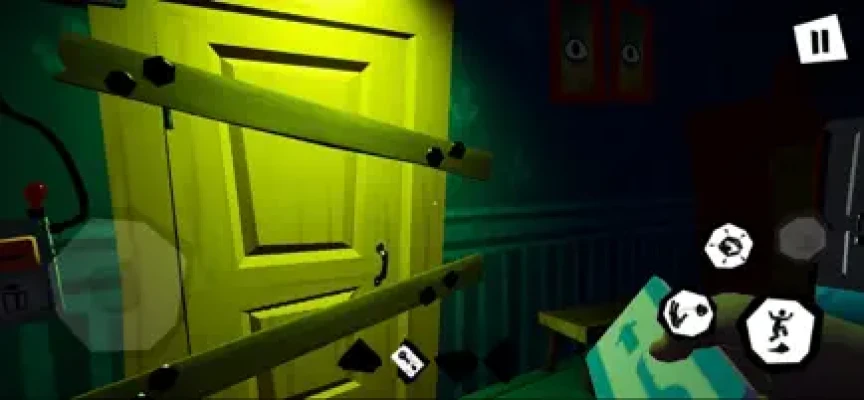
If you see a locked door, don't immediately assume the key is nearby.
The solution may require finding another route, manipulating an object or reaching an elevated section of the house.
Main Features
Adaptive AI
The Neighbor reacts to the player's behavior. Repeating the same approach can make previously useful routes less reliable.
Stealth Gameplay
Sneaking, hiding and choosing the right moment to move are central to progression.
Environmental Puzzles
The house contains interconnected puzzles where items, doors, switches and routes often work together.
Unusual House Design
The building becomes increasingly surreal as you progress, creating vertical exploration opportunities and unexpected shortcuts.
First-Person Exploration
The game relies heavily on looking around carefully and recognizing environmental clues.
Mobile Controls
The iOS version includes a touch-based interaction system and later received improvements to its interaction scheme. Bluetooth controller support was added in version 1.09.
Full Hello Neighbor Strategy Guide
1. Don't Treat the Game Like a Straight Walkthrough
One of the biggest mistakes beginners make is trying to move directly toward the next objective.
Hello Neighbor is deliberately built around experimentation.
If you see something that looks unusual, investigate it.
A seemingly decorative object may provide:
- A platform
- A hiding place
- A clue
- A shortcut
- A way to reach a higher level
- A connection to another puzzle
The house rewards curiosity.
2. Watch the Neighbor Before You Move
Before entering a new section, take a moment to understand where the Neighbor is.
Listen for his movement.
Look through windows and doorways.
Then decide which direction gives you the best chance of staying unnoticed.
Running blindly into the house usually creates more problems than it solves.
3. Learn His Patrol Behavior
The Neighbor isn't completely predictable, but you can learn patterns.
Pay attention to:
- Rooms he frequently visits
- Doors he tends to use
- Areas where he catches you
- Routes he takes after discovering you
- Places where he sets traps
If you keep getting caught in exactly the same location, assume your route needs to change.
The game's adaptive-AI concept specifically means repeatedly using the same tactic can become dangerous.
4. Don't Repeat Failed Routes
Suppose you enter through a window and get caught.
Trying exactly the same window again is usually a poor strategy.
Instead, ask:
What did the Neighbor learn from my previous attempt?
Then change at least one variable:
- Use another entrance
- Approach from another direction
- Wait longer
- Create a distraction
- Take a higher route
- Find another way through the house
This is one of the most important habits in the entire game.
5. Use Objects as Tools
Many objects are more useful than they initially appear.
Before leaving an area, consider whether an object could help you later.
Items can potentially function as:
- Puzzle components
- Climbing aids
- Distractions
- Access tools
- Route markers
- Objects that trigger environmental interactions
Don't assume that every item is meant to be used immediately.
6. Keep Track of Important Items
The house contains numerous objects, and it is easy to forget where you found something.
If you discover a key, tool or puzzle item, remember the location where you found it.
A simple mental system helps:
Item → Door/Mechanism → Location
For example:
Key → locked door → upstairs
This prevents you from wandering around later wondering what the item was supposed to open.
7. Think Vertically
Hello Neighbor isn't just a ground-level puzzle game.
Look upward.
The house frequently encourages you to think about:
- Balconies
- Windows
- Shelves
- Roof areas
- Platforms
- Boxes
- Stairs
- Elevated passages
If a door appears impossible to reach, there may be another route above or behind it.
8. Use Boxes Carefully
Boxes can be extremely useful for reaching elevated areas.
Instead of immediately throwing them around randomly, position them deliberately.
Think about:
Box + Box + Jump = New Height
If you are trying to reach a window or platform, place the boxes close enough to create a stable route.
However, don't build your entire strategy around one stack if the Neighbor is nearby.
9. Create Your Own Landmarks
The house becomes confusing very quickly.
Use recognizable objects and rooms as landmarks.
For example:
- The kitchen
- The staircase
- A large painting
- A distinctive window
- A hallway
- A room with unusual furniture
This makes navigation much easier than relying only on direction.
Stealth Strategy
Stay Out of the Center of Open Rooms
Open areas make you easier to spot.
Whenever possible, move around the edges of rooms and use furniture or walls to block the Neighbor's line of sight.
Don't Sprint Everywhere
Speed is useful when escaping, but constantly running makes stealth harder.
Move slowly when:
- You are approaching a new room
- You don't know where the Neighbor is
- You are carrying an important item
- You are near a puzzle
- You are trying to listen for footsteps
Sprint when you already know where you're going.
Use Distractions
If the Neighbor is blocking the route you need, consider whether you can draw him somewhere else.
A distraction can create enough time to:
- Enter another room
- Reach a staircase
- Grab an item
- Cross a hallway
- Escape through another route
The best distraction is one that gives you a clear objective while the Neighbor is occupied.
How to Escape the Neighbor
When you are discovered, don't immediately run in a straight line.
Instead:
- Identify the nearest escape route.
- Break his line of sight if possible.
- Turn a corner.
- Change elevation.
- Use another room or passage.
- Keep moving until you have enough distance to hide.
The important part is breaking pursuit, not simply creating distance.
If the Neighbor can see you continuously, he can often continue following your route.
Act 1 Strategy
Act 1 introduces the core mechanics and is the best place to learn how the house works.
Your early priorities should be:
- Learn the exterior
- Locate entrances
- Find useful objects
- Understand the Neighbor's movement
- Explore the first accessible rooms
- Identify routes into higher sections
- Learn how to escape when discovered
Don't worry about completing everything immediately.
Act 1 is an excellent opportunity to learn the game's logic.
Best Act 1 Approach
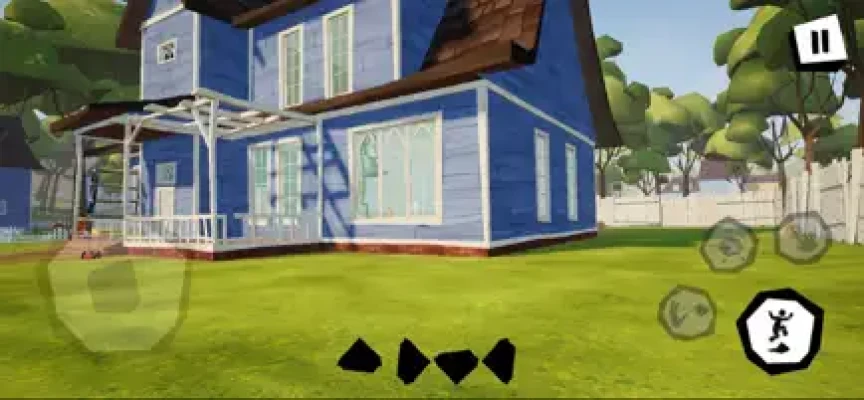
Start outside the house and examine the surrounding area.
Look for:
- Windows
- Doors
- Ladders
- Boxes
- Objects that can be thrown
- Alternate entry points
Then choose the least dangerous route into the house.
Once inside, explore systematically rather than opening every possible door at random.
Act 2 Strategy
Act 2 becomes more puzzle-focused and can feel much more restrictive.
The environment gives you less room to simply run around the house, so planning becomes more important.
A common mistake is repeatedly trying to solve a puzzle while the Neighbor is nearby.
Instead:
Scout → Understand the puzzle → Wait for an opening → Execute quickly
If you already know what you need to do, the actual attempt becomes much easier.
Act 2 Key Tip
Don't waste every attempt trying to make progress.
Some attempts should simply be reconnaissance.
Use one run to learn:
- Where the Neighbor goes
- Which doors are accessible
- Which objects are important
- Where you can hide
- Which route gives you the best escape
Then make your real attempt.
Act 3 Strategy
Act 3 opens the game into a much stranger and larger environment.
The biggest challenge is navigation.
You may find yourself asking:
Where am I supposed to go next?
The answer is usually connected to an environmental clue rather than a traditional quest marker.
Act 3 Priorities
- Learn the house layout
- Search vertically
- Keep useful items accessible
- Look for unusual mechanisms
- Pay attention to newly accessible areas
- Avoid repeating routes where the Neighbor has become effective
Some players particularly praise Act 3 for the exploration while criticizing its more confusing puzzle and fear sequences, so expect experimentation rather than a perfectly linear progression.
Basement Strategy
The basement is the ultimate destination of the central mystery, but reaching it is not simply a matter of finding one key.
Expect the final sections to combine:
- Exploration
- Environmental puzzles
- Movement
- Stealth
- Story sequences
- More unusual encounters
Don't rush into the basement without understanding the preceding puzzle chain.
When you reach a new basement area, pause and study it before moving.
Puzzle-Solving Method
When stuck, use this five-step process.
Step 1: Identify the Goal
What are you trying to reach?
A door?
A switch?
A room?
A basement section?
Step 2: Identify the Barrier
Why can't you reach it?
Locked door?
Height?
Missing item?
Blocked route?
Step 3: Search Nearby
Look for objects and mechanisms that could remove the barrier.
Step 4: Search Above
If nothing works at ground level, investigate elevated routes.
Step 5: Test Unusual Ideas
Hello Neighbor frequently rewards experimentation.
Try moving objects, throwing items, climbing structures and approaching the puzzle from another direction.
How to Deal With the Adaptive AI
The Neighbor is one of the game's defining features.
The official description gives examples of the AI reacting to repeated behavior, such as placing a bear trap around a frequently used window or adding cameras to a repeatedly used entrance.
That means you should vary your strategy.
Don't Always:
- Use the same window
- Enter through the same door
- Escape through the same hallway
- Hide in the same place
- Repeat the same distraction
Instead:
Rotate between several routes.
This makes the Neighbor's adaptation less effective against you.
Best Beginner Tips
- Explore before committing to a puzzle.
- Learn the house layout.
- Watch the Neighbor's movement.
- Don't repeatedly use the same entrance.
- Search vertically.
- Remember where important items are found.
- Use objects creatively.
- Break line of sight during chases.
- Create distractions when necessary.
- Use failed attempts as reconnaissance.
- Don't rush when you don't understand the puzzle.
- Change your route if the Neighbor starts countering it.
Common Mistakes to Avoid
Repeating the Same Entrance
The game is specifically designed to discourage predictable behavior.
Running Blindly
Speed doesn't help if you don't know where you're going.
Ignoring the Environment
The house itself is the game's biggest puzzle.
Forgetting Item Locations
You may need an object much later.
Staying in Open Areas
Open rooms give the Neighbor better opportunities to spot you.
Panicking During a Chase
A chase isn't automatically a failed attempt. If you can break his line of sight, you may still recover.
Solving Puzzles While Being Watched
If the Neighbor is nearby, concentrate on survival first.
Assuming Every Puzzle Has an Obvious Solution
Hello Neighbor often requires experimentation.
Advanced Strategy
Use Reconnaissance Runs
This is one of the strongest techniques for difficult sections.
During a reconnaissance run, don't worry about completing the objective.
Instead, learn:
- The Neighbor's route
- Important objects
- Safe hiding places
- Alternate entrances
- Escape paths
- Puzzle requirements
Then attempt the objective with that information.
Build a Route Network
Instead of memorizing one route, learn three.
For example:
Route A: Fast but exposed
Route B: Longer but safer
Route C: Vertical shortcut
If the Neighbor counters Route A, immediately switch to B or C.
Separate Exploration From Execution
Exploration should be slow.
Execution should be fast.
Once you know exactly what you need to do, stop wandering and perform the sequence quickly.
This dramatically reduces the amount of time the Neighbor has to interfere.
Mobile Controls and iPhone Tips
The current iOS version supports iPhone and iPad, with compatible devices beginning at iPhone 6s and iPad 5th generation, alongside newer supported devices. iPod touch devices are not supported.
The current App Store listing reports a download size of approximately 1.8 GB, so storage space is worth checking before installation.
Bluetooth controller support was added to the iOS version in version 1.09, while later updates introduced additional interaction and stability improvements. The current listing shows version 2.3.12 from April 16, 2025.
For touch controls:
- Adjust your grip before attempting difficult jumps.
- Avoid rushing camera movements.
- Use short camera movements when searching rooms.
- Practice picking up objects accurately.
- Learn the interaction button before attempting complicated puzzles.
- Consider a Bluetooth controller if touch controls feel uncomfortable.
Difficulty
Overall difficulty: Moderate to challenging
The controls themselves are not especially complicated.
The difficulty comes from uncertainty.
You often need to figure out:
- What to do
- Where to go
- Which item matters
- How to avoid the Neighbor
- How the house connects together
The adaptive AI can also punish repetitive strategies.
Recent App Store reviews continue to show divided opinions about the puzzle design. Some players praise the creativity and exploration, while others find certain acts frustrating or misleading.
Honest Review
Hello Neighbor remains one of the more distinctive stealth puzzle games on mobile.
Its strongest feature is the relationship between the player, the house and the Neighbor. You are not simply solving static puzzles; you're trying to solve them while another character actively interferes with your plans.
The first act is particularly approachable and gives players a strong introduction to the game's core concept. Later sections become more surreal and complicated, and opinions about the puzzle design are considerably more mixed. Current App Store reviews reflect that split, with some long-time players praising the concept and story while criticizing confusing puzzles and certain later sequences.
The game has also received continued iOS maintenance, including stability improvements and bug fixes, with version 2.3.12 listed on April 16, 2025.
If you enjoy stealth horror, puzzle games, exploration and unusual environments, it is worth trying.
Pros
- Unique adaptive AI concept
- Creative house design
- Strong stealth mechanics
- Interesting environmental puzzles
- Atmospheric presentation
- Lots of experimentation
- Memorable Neighbor character
- Large areas to explore
- Controller support on iOS
- Strong connection between exploration and puzzle solving
Cons
- Some puzzles can be confusing
- Later sections can become frustrating
- The AI can feel unpredictable
- Mobile controls require adjustment
- Large download size
- Some players may find the progression too unclear
Is Hello Neighbor Worth Playing?
Yes, particularly if you enjoy games that make you figure things out instead of constantly telling you what to do.
Hello Neighbor's greatest strength is the freedom to experiment. You can try different entrances, manipulate objects, explore unusual routes and learn from the Neighbor's reactions.
It is less suitable for players who want a straightforward, highly guided puzzle adventure.
The best way to enjoy it is to accept that getting caught is part of learning.
Frequently Asked Questions
What is Hello Neighbor about?
Hello Neighbor is a stealth horror puzzle game in which you sneak into a mysterious neighbor's house and investigate the secrets hidden inside, particularly beneath the house.
Does the Neighbor learn from you?
Yes. The game's central AI system is designed to react to the player's actions and can counter repeated approaches.
Is Hello Neighbor available on iPhone?
Yes. The current App Store version supports iPhone and iPad.
Does Hello Neighbor support controllers on iOS?
Yes. Bluetooth controller support was added in version 1.09.
What should I do if I keep getting caught?
Change your route. Avoid repeatedly using the same entrance or hiding location, and learn the Neighbor's current behavior before making another attempt.
How do I solve difficult puzzles?
First identify the objective and the obstacle preventing you from reaching it. Then search nearby for items, mechanisms and alternate routes. If nothing works, examine the area vertically.
Is the game scary?
It uses stealth-horror elements, pursuit and unsettling environments, but its stylized presentation makes it less focused on realistic horror. Apple rates it 9+ and identifies fear/horror-related content.
How large is Hello Neighbor on iOS?
The current U.S. App Store listing reports approximately 1.8 GB.
What iOS devices are supported?
The current listing supports iPhone 6s, iPad 5th generation, iPad Air 2, iPad mini 4 and newer compatible devices. iPod touch is not supported.
Game Information
- Game: Hello Neighbor
- Genre: Stealth Horror / Puzzle / Adventure
- Developer: Dynamic Pixels
- Publisher: tinyBuild LLC
- Platforms: iPhone, iPad
- Age Rating: 9+
- Language: English
- App Size: Approximately 1.8 GB
- Current U.S. App Store Rating: 4.0/5
- Ratings: Approximately 135K
- Controller: Bluetooth controller supported
- Current iOS Version: 2.3.12
- Latest listed update: April 16, 2025
- Supported starting devices: iPhone 6s and iPad 5th generation, with newer supported devices
Final Hello Neighbor Strategy Checklist
Before entering the Neighbor's house, remember:
- Observe before moving.
- Learn the Neighbor's patrol routes.
- Don't repeatedly use the same entrance.
- Search vertically as well as horizontally.
- Remember where useful items are located.
- Use objects creatively.
- Break line of sight during chases.
- Create distractions when necessary.
- Use reconnaissance runs for difficult puzzles.
- Keep multiple escape routes available.
- Change your strategy when the Neighbor adapts.
- Treat every failed attempt as useful information.
The key to Hello Neighbor is understanding that the house is not just a level—it is the puzzle itself. Once you stop trying to rush directly toward the objective and start studying the environment, the Neighbor and the routes around the house, the game's strange design begins to make much more sense.
Rate the Game
User Reviews














Popular Games


















 Android
 iOS
iOS Windows
 Xbox
Xbox